The Body Netflix Review: 8 Gripping Episodes Explored
Quinn Shephard’s eight-episode Netflix series The Body premiered on 11 November 2026. Our review covers the full main cast, official credits, critic scores and a 3.5/5 verdict.
 By Team Fashion Flavours
In this The Body Netflix review, we look at Quinn Shephard’s eight-episode coming-of-age horror drama, which arrived on Netflix on 11 November 2026. It is a new American series, not the 2019 Hindi film of the same name and not the Spanish thriller El cuerpo — a distinction worth making, because those older titles still surface in search results. All eight episodes dropped at once, and the show has already become one of the week’s most talked-about teen dramas.
The series is a raunchy, queer Y2K psychodrama with a streak of Catholic horror. It is stylish, often very funny, and frequently sharp about friendship, shame and belief. It is also longer than its story comfortably supports. Our verdict, after laying out the cast, the credits and the first wave of critic and audience scores, is 3.5 out of 5.
Content note: The Body is rated TV-MA. It includes drug use, sexual situations, strong language, religious trauma and mental-health distress, and it centres on teenage characters. The plot section below stays spoiler-light; later twists are left off the page.
The Body Netflix Review: Quick Facts
| Title | The Body |
|---|---|
| Type | Netflix original series, Season 1 |
| Creator / showrunner | Quinn Shephard |
| Key creative partner | Gina Gammell (executive producer and director) |
| Genre | Coming-of-age drama, mystery, psychological / supernatural horror |
| Premiere | 11 November 2026 (all eight episodes) |
| Episodes / runtime | 8 episodes, about 46–60 minutes each (roughly 7 hours 18 minutes in total) |
| Rating | TV-MA |
| Language / country | English (original); United States |
| Filming location | Toronto, Canada (official); additional Ontario locations reported |
| Production | North Road and Felix Culpa, for Netflix |
| Composer | Christopher Stracey |
| Choreographer | Ryan Heffington |
| Where to watch | Netflix |
| FashionFlavours rating | 3.5 / 5 |
Credits above are drawn from the Netflix Media Center title page, Netflix’s official series page and Shephard’s interviews with Netflix Tudum. Scores and critical excerpts are cited in the reception section, with figures checked on 17 November 2026 (Asia/Calcutta).
The Story, Spoiler-Light
The Body is set in the autumn of 2004 at St. Mark’s Catholic High School, somewhere in the American Northeast. The school’s all-girls dance troupe, the Lions, is two weeks from regionals and suddenly short a dancer. Co-captains and best friends Anya Butler (Kristina Bogic) and Elise Zakaria (Sara Boustany) hold emergency tryouts. Grace Franklin (Sofia Wylie) — the gifted, devout niece of the school’s priest and headmaster, Father Sam Franklin (Nnamdi Asomugha) — wins the open spot. New girl Lisbeth Anderson (Geena Meszaros) does not.
On Halloween night the Lions take the initiation somewhere it should never have gone. In an abandoned convent they nickname the Devil’s House, the girls drink, take ecstasy and jokingly offer Grace as a “virgin sacrifice” in exchange for a win at regionals. By morning, something is badly wrong with Grace, and the whole town starts asking the same question the official logline teases: what happened to her?
From there the series becomes a study of guilt, rumour and mass hysteria. The Lions begin to experience what they take to be prophetic visions. Secrets curdle into leverage. Lisbeth, who has her own reasons for wanting in, edges closer to Anya. Elise, who is already in love with her best friend, wants to be seen. Anya wants to keep her place at the top of the school’s food chain, even as she tries to bury her feelings for Elise. Father Franklin is left to tend a community that is coming apart, and to ask questions he may not be ready to answer.
Shephard has described the tone, in her Tudum interview, as “gritty camp”: “a raunchy teen psychodrama with a dash of Catholic horror.” She has also called the show a love letter to the 1990s and Y2K films she grew up on — Carrie, Jennifer’s Body, Heavenly Creatures and Mean Girls — “but with a grounded lens,” plus a long-standing fixation on Arthur Miller’s The Crucible. Those references are not window dressing. The Body is interested in how a closed, devout, status-obsessed world can talk itself into almost anything.
I’ve always been interested in the idea of girlhood as a religious experience. This story is definitely my way of putting a playful spin on all the nightmares of my own teenage-dom.
Quinn Shephard, to Netflix Tudum
Cast and Characters
The series regulars were announced in October 2025 and are confirmed on the official Media Center page. Brief character notes below are limited to what reputable reviews and official materials establish, without later-plot spoilers.
Main Cast
| Actor | Character | Who they are |
|---|---|---|
| Kristina Bogic | Anya Butler | Head captain of the Lions; the school’s hyper-vigilant queen bee |
| Sara Boustany | Elise Zakaria | Sharp-tongued co-captain and Anya’s best friend |
| Geena Meszaros | Lisbeth Anderson | A new-in-town misfit who wants into the group at any cost |
| Sofia Wylie | Grace Franklin | The gifted recruit at the centre of the Halloween night |
| Nnamdi Asomugha | Father Sam Franklin | Priest and headmaster of St. Mark’s; Grace’s uncle |
| Jackson Kelly | Leo Anderson | Lisbeth’s younger brother, earnest and out of step with the Lions |
| Shirley Chen | Maddie Delaney | A star Lion sidelined by injury as regionals approach |
| Louisa Krause | Catherine Anderson | Lisbeth and Leo’s strict, fundamentalist mother |
Key Supporting Cast
| Actor | Character |
|---|---|
| Motell Foster | Michael Franklin (Grace’s father) |
| Ashley Madekwe | Theresa Franklin |
| Orlando Norman | Steven Maxwell |
| Marcel Ruiz | Tyler Flores |
| Gabby Windey | Coach Shauna Miller |
| Kyra Pierce | Bailey Bradley |
| Phallon Pierce | Brit Bradley |
| Cale Ambrozic | Benji |
| Anna Tierney | Melanie Butler |
| Bella Neuspiel | Katie |
| Sarah Abbott | Olivia |
| Emily Roman | Claire |
| Michela Luci | Amy |
| Julia Lowe | Blair |
| Chloe Longname | Eden |
| Christine Solomon | Salma |
The young ensemble is the show’s strongest card. Almost everyone who has written about The Body comes back to two performances. The first is the chemistry between Bogic and Boustany. The Hollywood Reporter’s Angie Han calls it “beguiling,” and that is the right word: Anya and Elise have the private language of girls who have made a world out of each other, and the series is deliciously, unapologetically queer about that bond. Shephard told Tudum that this was Bogic’s first time doing an American accent, and the transformation is part of what makes Anya feel so tightly controlled — a girl performing popularity as if it were a second language.
The second, and the one critics have singled out most often, is Meszaros as Lisbeth. Han describes a “cloying singsong” and “skin-crawlingly off-putting” presence even when Lisbeth is barely doing anything. Clint Worthington, writing at RogerEbert.com, compared the effect to Morfydd Clark in Saint Maud and called Meszaros “a heart-stopping standout.” Lisbeth is not a subtle character — wounded people who want a “normal” teenage life, and will burn a house down to get it, rarely are — but Meszaros makes the mildness itself feel like a threat.
Kelly is the series’ soft counterweight as Leo, and Asomugha gives Father Franklin a grave, grounded authority as the adult most visibly trying to keep the school from tipping into panic. Wylie has the tougher job: Grace has to haunt the series without being reduced to a symbol, and she does enough in the early going to make the town’s obsession feel specific, not generic. Gabby Windey, in a smaller role as Coach Shauna Miller, is a welcome jolt of kooky charm; Han rightly treats it as a glorified cameo, but it is a sharp one. Chen’s Maddie, meanwhile, becomes one of the more affecting portraits of how a team, and a faith, can turn a girl’s body into a problem to be managed.
Episodes, Crew and Production
Netflix ordered the eight-episode series in May 2025. Shephard created it, wrote several instalments and directed four of them, including the premiere and the finale. Gina Gammell — Shephard’s closest creative partner on the show, and an executive producer for Felix Culpa — directed episodes five and seven. Kevin Phillips directed the middle pair. Executive producers include Amy Israel, Peter Chernin and Josh Stern for North Road; Riley Keough, Gammell and Sacha Ben Harroche for Felix Culpa; and M. Blair Breard. The Body is a reunion for Shephard and Keough, who previously worked together on the Emmy-nominated mystery Under the Bridge.
The official Media Center lists the filming location as Toronto, Canada. Local reporting in The Hamilton Spectator also placed part of the shoot at Columbia International College’s Northcliffe Campus in Dundas, Ontario, which stood in for the Catholic high school, along with other Hamilton-area sites in late 2025. The series is an American story, shot in Canada, and the winter light and institutional architecture do a lot of quiet work.
| No. | Title | Directed by | Written by | Runtime |
|---|---|---|---|---|
| 1 | Slutty God | Quinn Shephard | Quinn Shephard | 58 min |
| 2 | Jesus, Literally | Quinn Shephard | Quinn Shephard | 52 min |
| 3 | Unholy Thoughts | Kevin Phillips | Stuti Malhotra | 46 min |
| 4 | I Saw Grace Franklin With The Devil | Kevin Phillips | Julian Breece | 54 min |
| 5 | Faking It | Gina Gammell | Catherine Schetina | 57 min |
| 6 | Star Quality | Quinn Shephard | Quinn Shephard & Lily Houghton | 54 min |
| 7 | Holy Trinity | Gina Gammell | Story by Naledi Jackson; teleplay by Naledi Jackson and Julian Breece | 60 min |
| 8 | Coming Out | Quinn Shephard | Catherine Schetina & Greta Heinemann | 57 min |
Episode titles, directors and runtimes follow Netflix’s official listings; writing credits follow the published episode guide. Directors of photography, also from the Media Center, are Isiah Donté Lee (episodes 1, 2, 6 and 8), Bobby Shore (3 and 4) and Wyatt Garfield (5 and 7). Jennifer Morden is the production designer, Mirren Gordon-Crozier designed the costumes, and Ryan Heffington choreographed the dance work — a crucial credit on a show that treats the Lions’ routines as both spectacle and pressure cooker.
Direction, Look and Sound
Shephard has said she first wrote this story in her early twenties, the year she came out, and returned to it later with enough distance to see the comedy in the trauma. That revision is visible in the finished series. The premiere, which she directed, is the brashest hour: Halloween costumes, a mock ritual, and a tone that flirts with excess. Later episodes, especially those Gammell and Phillips handle, tighten the viselike social atmosphere and let the hysteria spread at a more measured, sometimes too measured, pace.
Variety’s Aramide Tinubu, who gave the series one of its warmest notices, is right about the period detail. The show actually lives in 2004: velour tracksuits, flip phones and multi-tap texting, AIM chat windows, and a soundtrack that makes room for early-2000s pop. Tinubu specifically flags licensed tracks by Chingy, Ciara and Kelly Clarkson. The point is not nostalgia for its own sake. As she notes, this is a world in which information moved quickly, but not instantly, and a lie could still be buried if enough people agreed to bury it. Composer Christopher Stracey scores the rest with a more liturgical unease, so the pop cues and the church cues keep rubbing against each other.
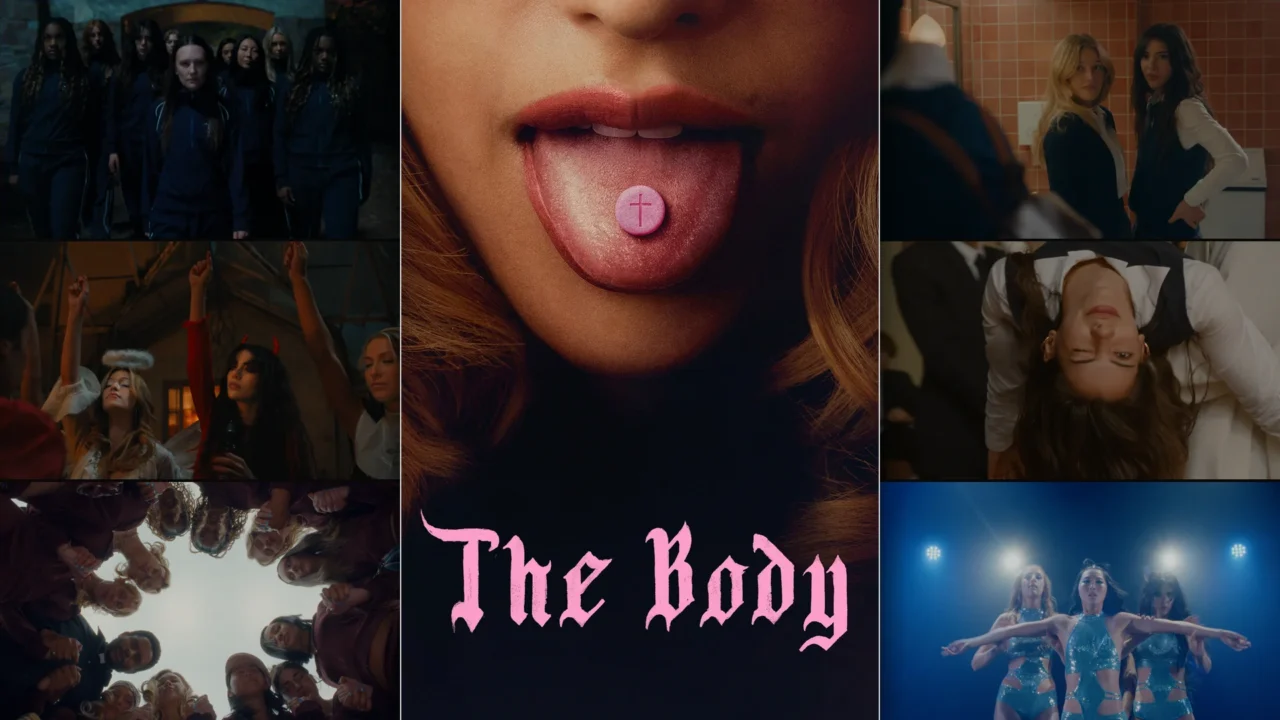
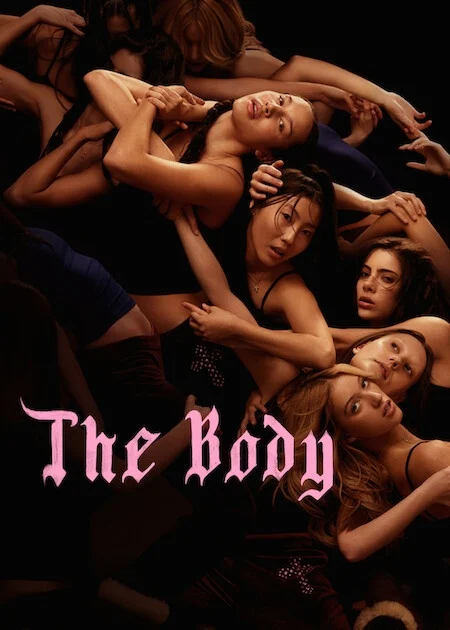
The visual style is more of a mixed bag. Daytime scenes have a textured, slightly chilly beauty, and Gordon-Crozier’s costumes do unusually precise work — Juicy-era leisurewear pressed up against uniforms, scapulars and “slutty” Halloween wings. But RogerEbert.com’s review fairly called out a familiar Netflix problem: night scenes that turn dim and muddy, so that you sometimes struggle to see what the blocking has gone to the trouble of arranging. The religious imagery is laid on thick: paintings of saints in ecstasy, sacred language used as flirtation, a pink communion-wafer of a pill in the alternate official key art. When the series trusts those images, it sings. When it only points at them, as Han argued in her more sceptical review, it feels like a thesis about faith and desire that it is not always brave enough to finish.
Pacing, Strengths and Weaknesses
The most consistent complaint from critics is also our biggest reservation: eight episodes is a stretch. Worthington wrote that even good writing can be hampered by “the languid pacing that comes from stretching your story out to eight hours.” Other notices suggested the same material might have been tighter at six, or even as a film. You feel that slack in the mid-season, when the rumour mill is turning and the show circles the same guilt, the same withheld confession, a little longer than it needs to.
Han’s other caution also sticks. Beyond the central trio of Anya, Elise and Lisbeth — and the quietly moving Leo — some of the ensemble is asked mainly to represent a theme. A promising pairing of Elise and Leo is, in her account, set aside once it has served a plot purpose. Father Franklin’s investigation supplies tension, but the series is less curious than it could be about what the crisis does to his own faith. Those are fair notes. The Body is better at starting arguments than at staying with them.
What it does extremely well is the social physics of a girls’ team. Tinubu is especially good on this: Lisbeth wants a normal adolescence and treats Anya as the door to it; Elise wants to be seen; Anya wants to hold her status at any cost. Each of them lies for what she lacks. The result, in the best stretches, is closer to Heavenly Creatures or Catherine Hardwicke’s Thirteen than to a conventional possession story. Importantly, several critics have stressed that the series never fully commits to a supernatural explanation — it is more interested in how a group of teenagers, in a rigid religious setting, can talk themselves into one. That ambiguity is a feature, not a dodge, and it is where The Body feels most like Shephard’s own “most personal” story, as she has called it: a satire of growing up queer and repressed, written with enough affection that even the mean girls are allowed to be human.
Critic and Audience Reception
As of 17 November 2026 (Asia/Calcutta), a few days after premiere, the first-wave scores that frame this The Body Netflix review are strong with audiences and generally favourable with critics:
- Rotten Tomatoes: 87% Tomatometer (23 reviews) and 97% Popcornmeter (1,000+ ratings) for Season 1.
- Metacritic: a Metascore of 73 (“generally favourable”) from 11 critic reviews, and a user score of 8.4 from 39 ratings.
- We could not independently confirm a live IMDb figure from the official title page at the time of writing, so we are not printing one here.
The critical split is easy to map. On one side is Tinubu’s Variety review, which calls the series “brilliant” and “an enthralling watch,” a “queer Y2K extravaganza” that understands female friendship, gossip and herd mentality. The Guardian’s Rachael Sigee, quoted on Metacritic, described it as a “queer-centric Mean Girls meets Carol Morley’s The Falling” and said its misbehaving teens “deliver infinitely more of a good time than the likes of Euphoria.” On the other side is Han, whose bottom line was “neither heavenly nor hellish,” and who argued that the show “does a finer job of paying tribute to its pop culture forebears than of staking its own claim among them.” Both views are defensible. The truth sits between a rave and a shrug: this is a distinctive, highly watchable series that does not quite stick the landing on all of its ideas, or on its running time.
If you are building a wider Netflix watchlist after this, our earlier looks at Alice in Borderland Season 3 and Inspector Zende sit in a very different register, as does the update on Dhindora Season 2. The Body is the one to put on when you want Catholic school corridors, dance-team politics and a slow, unholy dread rather than a game or a caper.
Who Should Watch
One last question a The Body Netflix review has to answer is who it is actually for. Watch The Body if you have a soft spot for Y2K teen cinema, for queer coming-of-age stories that refuse to stay in subtext, or for religious horror that is more interested in hysteria than in jump scares. Fans of Jennifer’s Body, Yellowjackets, The Crucible and mean-girl social thrillers will find the familiar notes, rearranged. It is also a strong showcase for a largely fresh young cast, which is reason enough if you like discovering performers before the industry finishes labelling them.
Skip it, or at least wait for a tighter recap, if you have little patience for an eight-episode binge that sometimes meanders, if supernatural ambiguity frustrates you, or if the TV-MA mix of teen sexuality, drugs and religious imagery is not what you want in a Sunday-night watch. This is not a family show, and it is not a straight horror series either.
Verdict and FashionFlavours Rating
Our The Body Netflix review lands at 3.5 out of 5. Shephard has made a personal, period-precise and often thrilling series about girls who use ritual — Catholic, social and satanic-as-a-joke — to survive each other. The central performances are excellent, the queer romance is treated as a heartbeat rather than a subplot, and the first half in particular has the snap of a film you would have rented too many times in 2004. The back half is where the length shows, and where some of the supporting stories thin out. That is not enough to sink the show. It is enough to keep us from joining the most breathless raves.
All eight episodes of The Body are streaming now on Netflix. As of this writing, a second season has not been officially announced; any renewal talk remains, for now, just talk.
FAQs
Is The Body a new Netflix series or a film?
It is a new eight-episode Netflix series, created by Quinn Shephard, that premiered on 11 November 2026. It is not the 2019 Hindi feature The Body and not the Spanish film El cuerpo.
How many episodes are there, and how long are they?
Season 1 has eight episodes, all released on the same day. Official runtimes range from 46 minutes (episode 3, “Unholy Thoughts”) to about an hour (episode 7, “Holy Trinity”). The full season runs a little over seven hours.
Who is in the cast of The Body?
The series regulars are Kristina Bogic, Sara Boustany, Geena Meszaros, Sofia Wylie, Nnamdi Asomugha, Jackson Kelly, Shirley Chen and Louisa Krause. Gabby Windey, Motell Foster, Ashley Madekwe, Orlando Norman and Marcel Ruiz are among the key recurring players. A full table is in the cast section above.
Where was The Body filmed?
The official Media Center lists the filming location as Toronto, Canada. Contemporary local reporting also described shooting in Dundas and other Hamilton-area locations in Ontario in late 2025.
Is The Body based on a true story?
No. It is an original story. Shephard has said she pulled from her own adolescence — including the experience of growing up queer and repressed — and from films and plays such as Carrie, Jennifer’s Body and The Crucible. It is not a dramatisation of a real case.
What did critics think, and what is the FashionFlavours rating?
As of 17 November 2026, Rotten Tomatoes lists an 87% Tomatometer and a 97% audience score; Metacritic lists a 73 Metascore. This The Body Netflix review gives the series 3.5 out of 5: a distinctive, strongly acted binge with a pacing problem.
Where can I watch it?
All eight episodes are on Netflix now. The show is rated TV-MA.
Final Thoughts
If you come to this The Body Netflix review looking for a simple yes or no, take the yes — with a caveat. Put a night aside, accept that the middle episodes breathe a little too freely, and let Shephard’s coven of Lions get under your skin. The best of the series is as alive as anything in recent teen television: messy, devout, horny, cruel and unexpectedly tender. The rest is a little longer than a prayer needs to be. For 3.5 out of 5, we would still light the candles and press play.



Leave a Reply